Program
| Composer | Work | Year |
|---|---|---|
| Wolfgang Amadeus Mozart | Violin Sonata No. 20 in C major, K. 303 | 1778 |
| Ludwig van Beethoven | Violin Sonata No. 8 in G major, Op. 30 No. 3 | 1802 |
| Eugène-Auguste Ysaÿe | Sonata No. 6 in E major (ded. Manuel Quiroga) | 1923 |
| Intermission | ||
| David Loeb | The Invisible River | 2019 |
| Maurice Ravel | Violin Sonata No. 2 in G major, M. 77 | 1927 |
| Fritz Kreisler | La Gitana | 1917 |
About the Artists
Emma Meinrenken
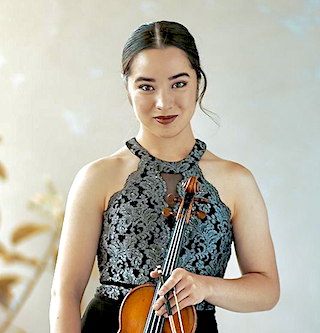
Praised for her effortless technique and virtuosity, as well as her skill in interpreting contemporary music, Canadian-German violinist Emma Meinrenken is a recipient of the 2023 Sylva Gelber Music Foundation Award, the 2023 Yale Presser Foundation Music Award, and a 2024 Yale Alumni Association Award. Upon graduating from the Curtis Institute of Music, where she studied with renowned pedagogue Ida Kavafian, Meinrenken received the Milka Violin Artist Prize. Originally from Toronto, Canada, she spent her formative years in the studio of Atis Bankas as a student in the Taylor Performance Academy for Young Artists. She has a Master of Musical Arts from Yale, where she was under the tutelage of the violin luminary Augustin Hadelich, and will start her doctorate degree at the CUNY in the fall.
She received 1st place at the Stradivarius International Violin Competition, the Prix Ravel at the Ecole d’Art Américaines de Fontainebleau, and has participated in festivals such as the NUME Festival in Italy, the Gstaad Menuhin Festival, the Verbier Festival Academy, the Norfolk Chamber Music Festival, and the Four Seasons Winter Workshop. Meinrenken debuted with the Toronto Symphony Orchestra in 2011, and has since performed with orchestras across North America and Europe. She often collaborates with composers, and has been the dedicatee of many new compositions for violin. She made her Carnegie Hall debut giving the New York premiere of a piece for violin and guitar by Fred Lerdahl, and most recently premiered a violin concerto by Maya Miro Johnson with the Curtis Symphony Orchestra.
She currently plays on the 1717 Windsor-Weinstein Stradivarius violin, generously on loan from the Canada Council for the Arts.
Thomas Weaver
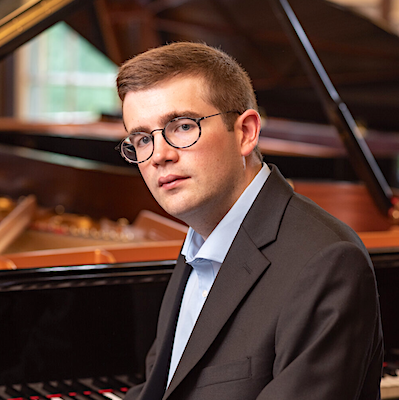
Thomas Weaver is an American pianist, composer, and educator. His extensive repertoire contains music of the past as well as new compositions, including many pieces written especially for him. A native of Marlton, NJ, he began his study of piano at the age of eight, giving his first public performance at the age of nine. He is currently based in Philadelphia.
Thomas Weaver maintains an active and chamber career that has included performances in the United States, Europe, and Asia. His playing has been hailed as displaying both sensitivity and incredible dexterity. Weaver has appeared in many concert halls, including those in New York (Carnegie/Weill Recital Hall, Greene Space, Lincoln Center, Merkin Hall), Philadelphia, Washington D.C. (Phillips Collection), Boston (Jordan Hall), Chicago, Nashville, Dallas, Berlin (Germany), Itami (Japan), the Tanglewood Music Festival, Red Rocks Music Festival, New York Chamber Music Festival, and others. Weaver has performed with a number of eminent musicians including Elmira Darvarova, Jess Gillam, Kenneth Radnofsky, Jennifer Frautschi, Gene Pokorny, and members of the Metropolitan Opera Orchestra, New York Philharmonic, Philadelphia Orchestra, Boston Symphony Orchestra, and others. Weaver is a currently a member of the Amram Ensemble, Trio Ardente, and New England Chamber Players.
Weaver is on faculty at the Curtis Institute of Music in Philadelphia, where he teaches Core Studies (harmony, counterpoint, and analysis), Keyboard Studies, and Supplementary Piano. He is a staff pianist and accompanist at the Boston University Tanglewood Institute and at Mannes College. He holds a Master of Music degree in both Piano Performance and Composition from Mannes College, and a Bachelor of Music degree, summa cum laude, from Boston University. His primary piano teachers include Anthony di Bonaventura, Victor Rosenbaum, and Pavel Nersessian. His primary composition instructors include David Loeb, Dr. John Wallace, Dr. Martin Amlin, and Jonathan Coopersmith.